

Policy briefs -
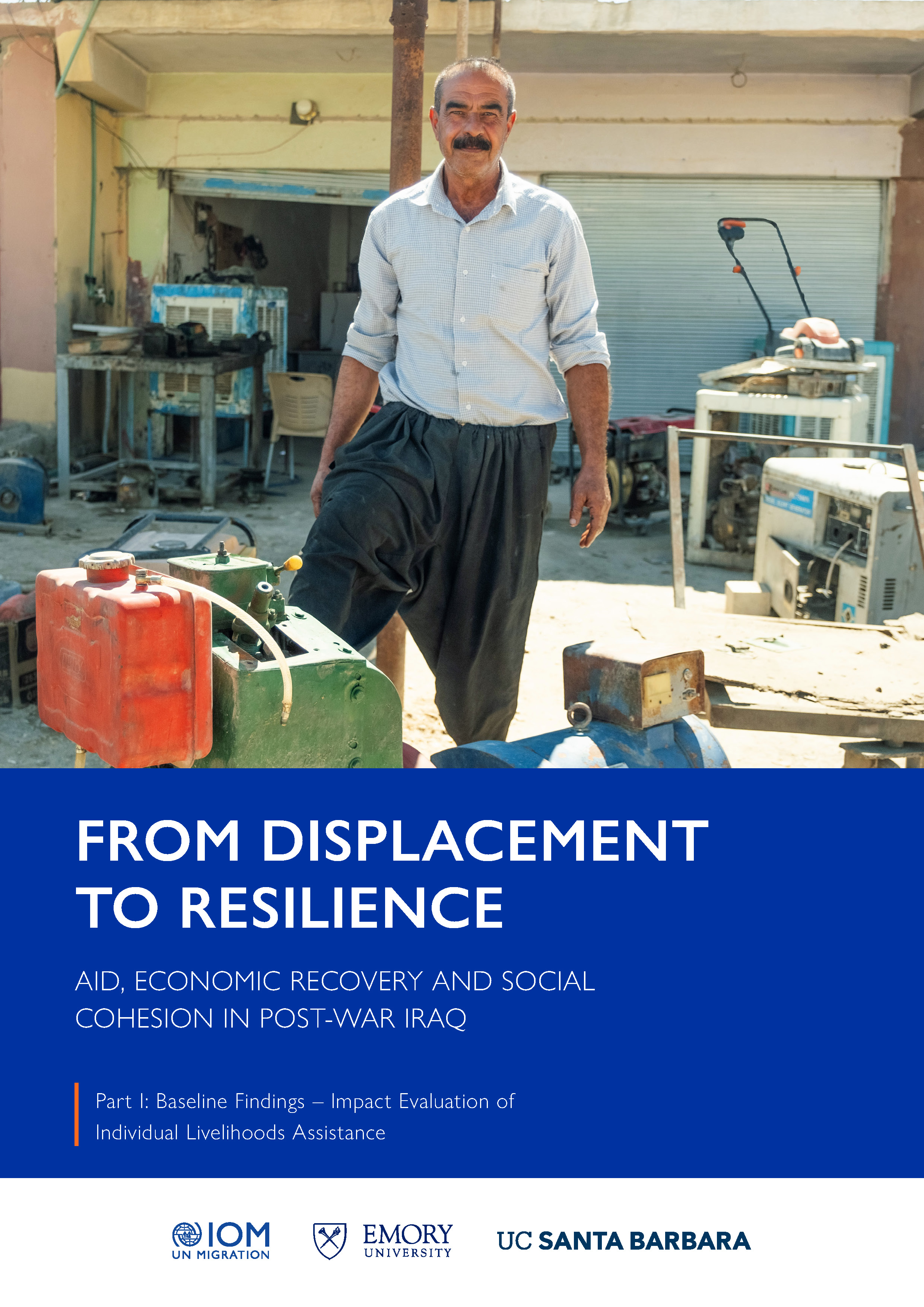
From Displacement to Resilience: Aid, Economic Recovery, and Social Cohesion in Post-War Iraq
Policy briefs -
From Displacement to Resilience: Aid, Economic Recovery, and Social Cohesion in Post-War Iraq
Part I: Baseline Findings – Impact Evaluation of Individual Livelihoods Assistance
Large-scale displacement and return can disrupt the economic and social fabric of communities, leading to intergroup tensions and increased competition over resources. Iraq has experienced high levels of displacement caused by the 2014 conflict with the Islamic State of Iraq and Levant (ISIL). As of August 2024, 1.1 million Iraqis remain internally displaced, while an addition 4.9 million have returned to their area of origin after displacement (DTM Iraq, 2024). IOM Iraq implements a range of livelihoods programs to support economic recovery and resilience in communities affected by forced displacement, one of the largest interventions being microenterprise grants known as Individual Livelihood Assistance (ILA).
This baseline report is the first in a series of publications that will be produced as part of a randomized controlled trial to evaluate the impact of the ILA program in the governorates of Anbar, Diyala, Salah Al-Din, and Ninewa. Based on over 6,000 survey interviews, this report describes baseline economic conditions and social cohesion among people targeted by the ILA program and the surrounding communities, providing evidence of a robust correlation between economic vulnerability and different dimensions of social cohesion. Based on these findings, the report provides evidence-based guidance for policymakers and practitioners supporting local recovery efforts in Iraq and similar post-conflict settings.